
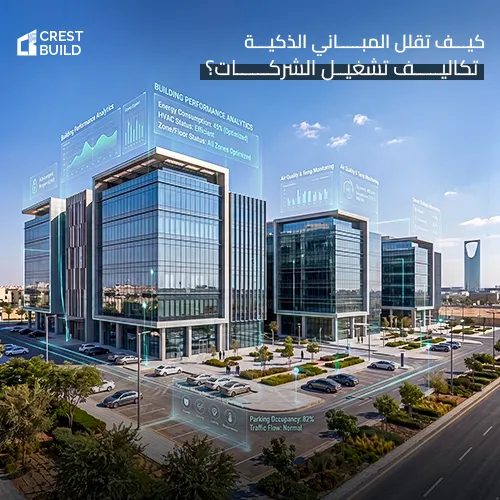
What Are Smart Buildings?
A smart building is a facility equipped with integrated technology systems — sensors, automation, and data analytics — that monitor and control core operational elements like lighting, air conditioning, security, and space management automatically or semi-automatically, rather than relying entirely on traditional manual control.
Smart Building Management Systems (BMS)
A Building Management System monitors energy consumption in real time and controls air conditioning and lighting based on actual space occupancy, instead of running systems at full capacity even when spaces aren't actively in use. This precise control alone can reduce electricity bills by a noticeable margin over the course of a year.
Smart Lighting and Climate Control
-
Motion sensors that automatically turn off lighting in unused rooms and spaces.
-
Automated scheduling systems for air conditioning and lighting based on the company's actual working hours.
-
Daylight sensors that adjust artificial lighting intensity based on available natural light.
Predictive Maintenance and Reduced Equipment Failures
Instead of traditional scheduled maintenance or waiting for a breakdown to occur, smart buildings rely on sensors that monitor equipment performance (HVAC, elevators, electrical systems) and alert the technical team before an actual failure happens. This predictive maintenance reduces emergency repair costs, extends equipment lifespan, and minimizes downtime that could disrupt business operations.
Smart Security and Surveillance
Smart access control and surveillance systems reduce the need for large traditional security staff, while also providing a higher level of accuracy in tracking entry and exit. This translates into lower security operating costs while improving the overall level of protection at the same time.
Efficient Space Utilization
Smart room and desk booking systems help companies understand how their spaces are actually being used, allowing them to redistribute space more efficiently and reduce leasing or operating more square footage than they actually need.
Return on Investment Despite the Initial Cost
Fitting out a building with smart systems can cost more upfront compared to traditional fit-out, but over the medium and long term, savings on energy bills, maintenance costs, and overall operational efficiency cover that additional cost — turning the investment into a genuine profitability factor rather than just a technical luxury.
Crest Build's Role in Integrating Smart Building Solutions
Crest Build in Riyadh offers integrated services covering construction, interior and exterior finishing, and interior design, with the ability to integrate smart building management systems directly into commercial fit-out projects from the design stage — ensuring companies equip their premises with the latest operational efficiency standards from day one.
Frequently Asked Questions
Are smart buildings only suitable for large offices?
No, smart building solutions can be implemented at different scales to suit small and medium spaces as well, depending on the company's needs and budget.
How much can a company expect to save on electricity bills with a building management system?
Savings vary depending on building type and usage patterns, but smart control of lighting and air conditioning typically achieves noticeable savings over the course of a year compared to traditional systems.
Can smart building systems be integrated into an existing building, not just a new one?
Yes, many smart building solutions can be integrated into renovation and fit-out projects for existing buildings, depending on the available infrastructure.
Is the cost of a smart building fit-out worth the additional investment?
In most cases, yes — the savings on energy and maintenance costs over the medium and long term cover the additional upfront cost and turn it into a genuine profitability factor.
Conclusion
Integrating smart building solutions into your commercial project is a long-term investment that saves you more than just costs — it delivers higher operational efficiency. Contact Crest Build today to discuss integrating these solutions into your next project.