
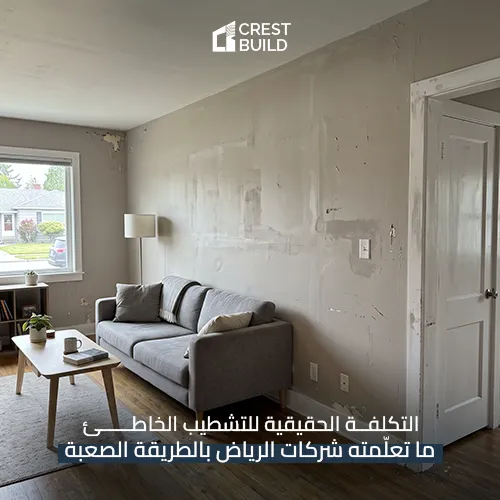
In Riyadh's fast-moving commercial real-estate market, where businesses are scaling quickly and office spaces are being fitted out at a pace the city has never seen before, the pressure to move fast and spend less is real. But the shortcuts that seem attractive at the beginning of a project have a way of becoming very expensive by the end of it.
This article is a frank look at where fit-out projects go wrong, what the actual financial consequences are, and how to protect your investment by making the right decisions from day one.
The Three Phases Where Fit-Out Projects Fail
Poor fit-out outcomes almost always trace back to failures in one of three phases: planning, execution, or materials specification.
Planning failures are the most expensive. When a project starts without a complete and properly documented scope of works, changes become inevitable — and in construction, changes cost money. Every variation order issued mid-project typically costs between two and five times the equivalent work would have cost if planned correctly from the start. This is not because contractors are opportunistic (though some are). It is simply because mid-project changes disrupt workflow, require remobilisation of trades, and often require completed work to be undone.
Execution failures are the most visible. Substandard workmanship — poorly fitted ceilings, uneven flooring, inconsistent paint finishes, plumbing that leaks — becomes apparent quickly once a space is occupied. Beyond the aesthetic problem, there are frequently practical consequences: MEP systems that do not perform as specified, air conditioning that cannot maintain temperature, lighting circuits that trip. These issues require rectification, which means disruption to your business operations and costs that the original contractor is often unwilling or unable to absorb.
Materials failures are the most insidious. A contractor who uses cheaper materials than those specified can deliver a space that looks acceptable on the day of handover but begins to deteriorate within twelve to twenty-four months. Floor finishes that were not rated for commercial use start to show wear. Partition systems that were not acoustically specified allow sound to travel between offices. Paint applied without proper priming begins to peel. These failures are hard to attribute clearly to the contractor by the time they become apparent, making recovery difficult.
What Bad Fit-Out Actually Costs — Beyond the Rectification Bill
The direct cost of rectifying a failed fit-out — tearing out and replacing substandard work — is significant. But the indirect costs are often larger. During the period when your space is being fixed, your business is disrupted. If your team cannot work effectively, or if clients or customers are seeing a space that does not reflect your brand standards, there are real commercial consequences.
For businesses that have taken on lease obligations based on an expected occupancy date, delays in fit-out completion generate real financial exposure: paying rent on a space you cannot use while simultaneously paying for temporary accommodation elsewhere. In Riyadh's current commercial leasing market, this is not a theoretical scenario — it is something CREST BUILD clients have come to us to resolve after previous contractors failed to deliver.
There is also a less quantifiable but equally real cost: the management time and mental energy consumed by a problem fit-out. Senior decision-makers who should be running their businesses find themselves managing contractor disputes and quality inspections instead.
How to Protect Yourself: The CREST BUILD Approach
The most effective protection against a bad fit-out is a rigorous contractor selection process. Beyond that, there are three specific contractual and process protections that make a significant difference.
First, insist on a detailed scope of works document before any contract is signed. This document should specify every element of the fit-out — finishes, systems, dimensions, materials — to a level of detail that removes ambiguity. Any contractor who is reluctant to work to a detailed scope is signalling that they intend to use that ambiguity to their advantage.
Second, require a payment structure linked to verified milestones rather than a time-based schedule. Payment should follow confirmed completion of defined phases — not simply the passage of time or the contractor's request.
Third, retain a percentage of the contract value — typically five to ten percent — as a defects liability retention, released only after a defined defects liability period has elapsed without significant issues. This gives the contractor a financial incentive to resolve any post-handover issues promptly.
CREST BUILD works to a fully documented process on every project. Our clients receive a complete scope of works, a milestone-linked project programme, material submittals before work commences, and a defined defects liability period backed by our company's warranty commitment. This is not unusual in the international fit-out industry — but it is rarer than it should be in the Saudi market, and it is one of the reasons our clients return to us for successive projects.
The Right Fit-Out Pays for Itself
A well-executed fit-out is not just the absence of problems. It is a space that makes your business more productive, your brand more credible, and your staff more engaged. These are not soft benefits — they are measurable commercial outcomes that compound over the years you occupy the space.
The businesses that understand this invest properly in their fit-outs and choose contractors who can deliver quality at scale. The businesses that learn it the hard way wish they had made a different choice at the beginning.
CREST BUILD delivers interior design, fit-out, renovation, and construction services across Riyadh. If you are planning a project, we invite you to begin with a conversation.