
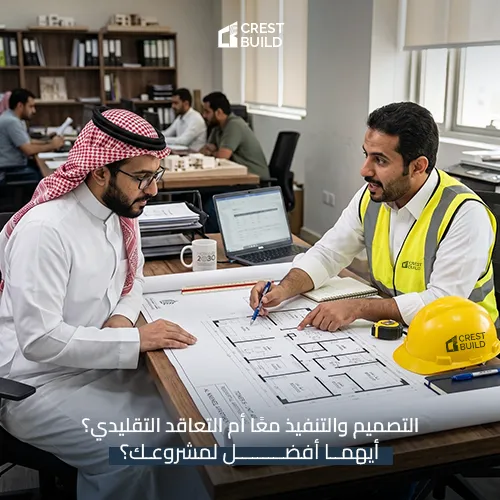
What Is Design & Build?
In the Design & Build model, a single company manages the entire project—from architectural design and planning to construction, fit-out, and final handover.
Having one team responsible for the whole process simplifies communication and reduces coordination challenges.
What Is Traditional Contracting?
Traditional contracting separates the design and construction phases.
The client first hires an architect or design consultant and then appoints a contractor to execute the project based on the completed design.
While this provides greater flexibility in selecting consultants and contractors independently, it often requires more coordination throughout the project.
Comparing the Two Approaches
Project Timeline
Design & Build allows construction activities to begin while certain design elements are still being finalized, reducing the overall delivery time.
Traditional contracting requires the design to be fully completed before construction starts.
Cost Management
Because design and construction teams work together from day one, Design & Build often reduces costly changes and minimizes conflicts during execution.
Traditional contracting may result in additional costs if design revisions occur after construction begins.
Risk Allocation
With Design & Build, responsibility rests with one company, making accountability much clearer.
Traditional contracting can sometimes lead to disputes over whether a design issue or construction issue caused a problem.
Flexibility
Traditional contracting may be preferable for highly customized projects where the owner wants maximum control over design decisions.
Design & Build is generally ideal for clients seeking faster delivery, simplified management, and a single point of responsibility.
When Is Design & Build the Best Choice?
It is particularly suitable for:
-
Commercial buildings
-
Office spaces
-
Restaurants and cafés
-
Retail stores
-
Hotels
-
Fast-track developments
-
Investors seeking a single project partner
When Is Traditional Contracting Better?
Traditional contracting may be the better option if:
-
The architectural design is highly specialized.
-
The owner wants to appoint consultants and contractors independently.
-
Multiple design review stages are required before construction.
How Crest Build Supports Your Project
Crest Build delivers fully integrated solutions including:
-
Construction services
-
Interior design
-
Interior and exterior fit-out
-
Renovation and rehabilitation
-
Residential and commercial project execution
By managing every stage under one roof, Crest Build helps clients reduce delays, improve coordination, and achieve consistent quality throughout the project lifecycle.
View Crest Build Projects
To explore examples of Crest Build's completed projects and services, visit the company's listing on Haraj:
👉 https://haraj.com.sa/11183873334
Frequently Asked Questions
Is Design & Build more cost-effective?
For many projects, it reduces unexpected costs by minimizing redesigns and improving coordination.
Is it suitable for commercial developments?
Yes. It is one of the most common delivery methods for commercial projects because of its efficiency and speed.
Can the design be changed during construction?
Yes, although minimizing changes is recommended to avoid additional costs and delays.
Does Crest Build provide both approaches?
Crest Build offers flexible solutions tailored to each project's needs and can help determine the most suitable delivery model.
Conclusion
Choosing between Design & Build and traditional contracting depends on your project's priorities. If you value speed, streamlined communication, and single-source accountability, Design & Build is often the preferred solution for today's commercial and residential developments.