
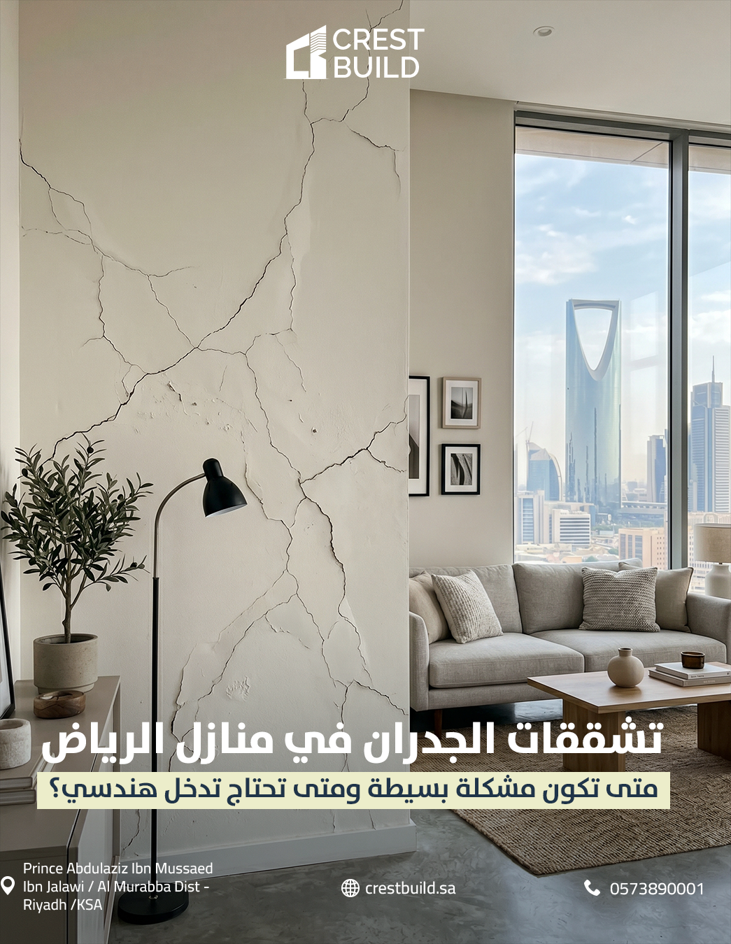
When are wall cracks considered dangerous in Riyadh homes? Wall cracks are considered minor and non-hazardous when they are superficial hairline cracks under 2mm wide, typically confined to the plaster or paint layer. However, they require immediate engineering intervention if they appear diagonally at a 45-degree angle near doors and windows, or as wide, deep horizontal cracks that expand over time due to foundation settlement. Crest Build offers technical inspections using advanced structural auditing tools to safely diagnose and remediate these issues.
Common Types of Structural and Superficial Wall Cracks
-
Hairline and Surface Cracks: Frequently observed in interior paint or exterior plaster layers. They occur due to rapid moisture evaporation caused by Riyadh’s intense heat. These are purely cosmetic and easily repairable.
-
Shrinkage & Joint Cracks: These develop along the intersection of differing structural materials, such as the direct joint between concrete columns and cement blockwork, usually caused by omitting metal lath wire mesh during plastering.
-
Deep Structural Fractures: The most hazardous classification, penetrating deep into the block walls and load-bearing concrete elements. They are direct symptoms of severe foundation shifting or uncalculated load stresses.
Engineering Solutions and Remediation by Crest Build
At Crest Build, our engineering team utilizes crack-monitoring gauges and non-destructive digital devices to determine if a structural fracture is active (expanding) or static (stabilized). Once evaluated, a localized engineering plan is implemented, aligning with the safety frameworks outlined on
-
Structural Epoxy Injection: Injecting high-density, low-viscosity structural resins to stitch fractured blockwork and concrete elements together.
-
Underpinning & Foundation Stabilization: For foundation settlement cases, our teams reinforce existing footings, expand concrete jackets, or execute specialized soil compaction injections under the structure.
-
Cosmetic Finishing Restoration: Once stabilization is mathematically verified, our finishing team cleans the joint, applies heavy-duty fiberglass mesh, and smooths the wall with premium compounds to restore a pristine finish.
Frequently Asked Questions (FAQ)
-
Can a 45-degree diagonal crack be fixed permanently? Yes, but only after identifying and halting the root cause (such as structural settlement or water leaks under the footing). Once settled, it is structurally reinforced and sealed.
-
Does home insurance in Saudi Arabia cover structural wall cracks? Mandatory inherent defect insurance policies (like Maladh) cover major structural faults and foundation issues for up to 10 years from construction completion.